

Floating Slab Foundation — What It Is, Pros and Cons
Every garage, shed, workshop and light addition to your property starts with a foundation decision that determines the project’s timeline and long-term performance. For homeowners, property owners and builders facing site challenges like difficult soils or limited access, a floating slab foundation can open options without extensive excavation or frost line footings.
Learn about the pros and cons of a floating slab foundation to decide whether it’s suitable for your project.
What Is a Floating Slab Foundation?
A floating slab foundation consists of a single concrete pad poured directly onto compacted gravel without separate footings below the frost line. The entire slab moves slightly as a single rigid unit during minor soil shifts caused by moisture changes, freeze-thaw cycles or natural settlement.
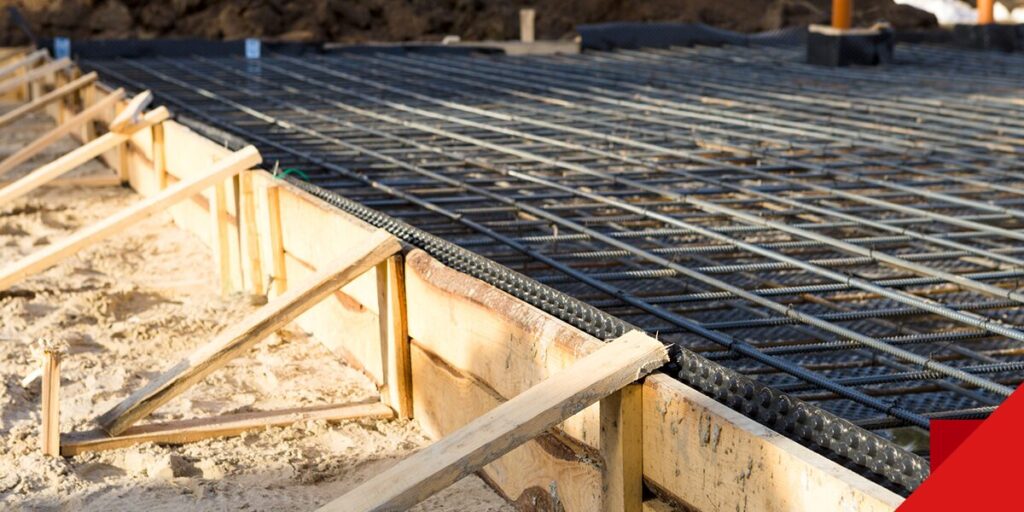
Standard thickness ranges from 3.5 to 6 inches across the floor area, with thickened perimeter edges that function as integrated grade beams. Perimeter edges distribute loads evenly and provide structural support.
Steel rebar or wire mesh reinforcement throughout the concrete provides tensile strength and maintains integrity for decades. Builders choose floating slab concrete foundations specifically for structures without underfloor access requirements, making this a shallow foundation system.
The Advantages of a Floating Slab
A floating slab delivers multiple performance and economic benefits when matched to the appropriate building project and site conditions.
- Reduced installation costs: Eliminates deep excavation, heavy footings and extensive formwork to create the most economical foundation option available.
- Accelerated project completion: Requires only a few days to install, depending on scope and inspections, plus three to nine days for curing.
- Enhanced soil compatibility: Distributes weight evenly across a wide footprint and performs well on soils with lower bearing capacity.
- Minimized moisture issues: Prevents hidden damp environments where mold and pests can develop, thanks to the absence of crawl spaces or basements.
- Simplified utility installation: Makes pre-pour placement of plumbing and electrical systems easier during initial setup.
- Immediate surface readiness: Provides a finished floor, eliminating the need for additional flooring in workshops and garages.
The Disadvantages and Risks to Consider
Every foundation system has performance boundaries and specific conditions that require careful attention during planning and installation. Understanding where floating slab foundation problems arise helps property owners make informed decisions based on actual project requirements and site characteristics.
- Frost heave susceptibility: Slabs above the frost line experience uneven lifting as freezing soil moisture expands, unless proper insulation and drainage mitigate seasonal ground movement.
- Load capacity limits: Foundations support only light single-story detached buildings and cannot accommodate multistory structures or concentrated equipment weight.
- Settlement and cracking potential: Concrete slabs on poorly compacted soil develop differential settlement in expansive clay or in areas with significant ground movement.
- Moisture infiltration risk: Perimeter drainage that fails or insufficient vapor barriers allow water to seep beneath slab edges, leading to mold development.
- Utility access restriction: Plumbing or electrical repairs after installation require cutting into cured concrete.
- Site preparation demands: Compaction or drainage shortcuts create performance issues that require remediation via polyjacking or piering.
Is a Floating Slab Right for Your Project?
Determining foundation suitability requires matching project characteristics against performance parameters. A floating slab foundation is good for projects with verified soil stability and confirmed light structural loads.
Ideal Use Cases
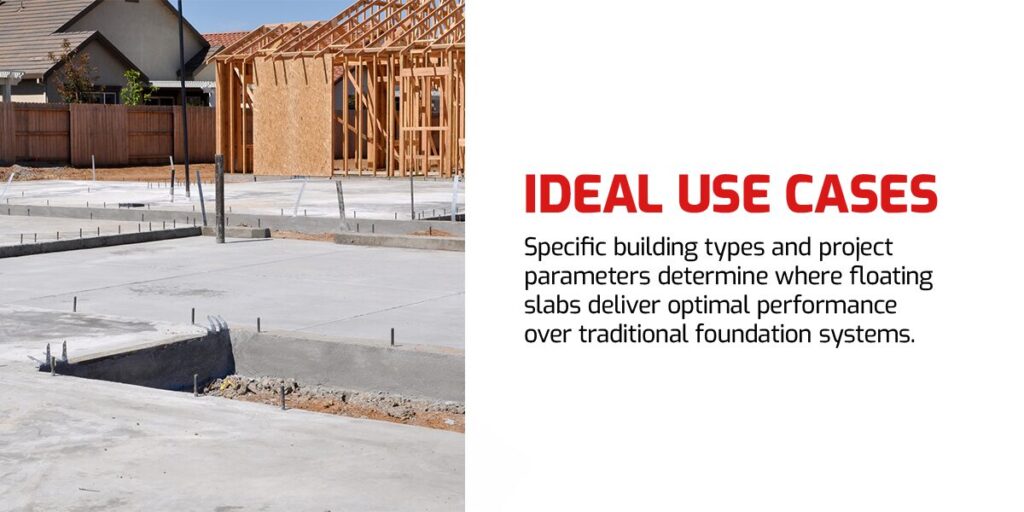
Specific building types and project parameters determine where floating slabs deliver optimal performance over traditional foundation systems. Light structural demands and straightforward access requirements create the best conditions for long-term success.
Floating slabs deliver the best value in applications such as:
- Detached garages and workshops
- Storage sheds and outbuildings
- Small cabins and seasonal homes
- Single-story residential additions
- Modular and prefabricated structures
Critical Factors to Evaluate
Before committing to a floating slab foundation, you’ll need to assess four site-specific conditions that determine whether the design fits your project.
- Soil type and bearing capacity: Geotechnical evaluation confirms whether your soil can support the slab’s weight distribution.
- Structural load limits: Combined dead and live loads must fall within single-story, light-load parameters.
- Local building codes: Frost depth protection, reinforcement standards and vapor barrier specifications vary by jurisdiction.
- Site grading and water management: A relatively level surface and a manageable water table provide the best conditions for the slab.
A Quick Look at the Construction Process
Quality installation requires careful steps, with site preparation and control determining long-term performance. Contractors who are familiar with local soil conditions recognize when compaction meets requirements and finishing techniques prevent surface defects. Completion occurs within days when the weather cooperates and materials arrive on schedule.
Site Preparation and Formwork
Thorough groundwork determines whether the slab will perform reliably for decades or develop premature cracking and movement.
- Clear the construction area: Remove all vegetation and debris for unobstructed equipment access.
- Grade and compact native soil: Level and compress the soil to eliminate soft spots that cause differential settlement.
- Install gravel base layer: Spread and compact 4 to 6 inches of crushed stone for drainage.
- Erect perimeter formwork: Position wooden forms around the exact dimensions to contain the pour.
Reinforcement and Pouring
Accurate reinforcement placement and concrete handling techniques determine the slab’s structural strength and surface quality throughout its service life.
- Install moisture barriers: Place vapor barrier sheeting over the gravel base to control groundwater migration.
- Position steel reinforcement: Set rebar or a wire mesh grid with the correct spacing to maintain centering within the slab depth.
- Pour concrete monolithically: Place concrete in one continuous operation, working it into all form areas to eliminate voids.
- Finish the surface: Vibrate, screed and float the concrete to achieve a smooth, level surface with proper drainage slope.
Curing and Finishing
Controlled curing develops full concrete strength and helps prevent surface cracking that could compromise the durability of a floating slab over time.
- Maintain continuous moisture: Keep the slab moist for the specified duration using curing compounds, plastic coverings or wet burlap.
- Extend curing time: Allow additional days when weather or concrete mix specifications require longer hydration periods.
- Carefully remove formwork: Strip forms after initial hardening, then smooth all exposed edges and apply sealers.
- Verify strength before use: Confirm the slab reaches the specified compressive strength before placing any loads on the surface.
Get Started With R. J. Potteiger Construction Services, Inc.
A floating slab foundation can simplify your build and reduce costs when site conditions and structural loads align with the design.
R. J. Potteiger Construction Services, Inc., manages every phase of your foundation project, from site assessment to final finishing. With over 30 years of experience across Central Pennsylvania, our team brings the skills and hands-on experience to keep your floating slab strong and reliable year after year.
Contact us today to schedule your site assessment or request a tailored quote.